James and the Wisdom of Sirach

Karen Jobes argues James assumes Jewish wisdom literature, although he “transposes it by Jesus’ teaching” (Letters to Christians, 206). By the time of the New Testament, Jewish wisdom literature (like Proverbs) had come into contact to Greek ethical teaching (like the Stoics or Epicureans). The book of Sirach (written about 200 B.C., but translated into Greek two generations later). The book was popular in the first century and reflects an attempt to teach the wisdom of the Hebrew Bible in a world infused with Greco-Roman ethics.

WisdomThere are several similarities between wisdom literature and James. First, Proverbs 9 and Sirach 24 closely relate wisdom and Law. Sirach teaches that the Torah as the essential path to attaining wisdom, but is not identical to wisdom. If this is true, then the path to wisdom must come through Israel, the nation to whom the Law was entrusted. Sirach 24 says that God commands wisdom to “dwell in the tents of Jacob.” For James, living a life according to the “Royal Law” is more or less equivalent to living a life of Wisdom.

Second, in Sirach, wisdom is clearly a gift of God (Sirach 20:9-12, 1:1-10, 42:17-19, 43:32-33). This theme is sounded in the very first verse of the book, “All wisdom is from the Lord” (Sirach 1:1, 10, 24:3-7). So too in James 1:5: “if anyone lacks wisdom, you should ask God for it.”  James does not recommend the ethics of the Greco-Roman world because God is the source of wisdom, it is all a gift of God.

Sirach always describes the process of obtaining wisdom as an act of the will: one must choose wisdom (6:18f, 15:15). Other verbs are used: one must seek (4:12), hold on to (4:13), serve (4:14), obey (4:15), chain one’s self to wisdom and carry it on your back (6:24-25). Attaching one’s self to an elder or other wise man is a critical step in attaining wisdom (6:34-36, 8:8-9). So too James, where a life of wisdom is an active choice to act (James 3:13-14).  A person is not wise, but his actions are wise.  Like most wisdom literature, one does wisdom in James.

Obedience to the Law and fear of God is a requirement for receiving Wisdom as a gift (Sirach 2:15-16, 20:19, 41:8). In fact, one might argue that many of the wise sayings in Sirach are meditations on the Torah. The person who holds to the Law will obtain wisdom (Sirach 15:1, cf 4:16). James also sees keeping the good, perfect, or Royal Law as pre-requisites for a life of Wisdom (James 2:8-11).

Jobes points out that while there are similarities to Sirach, James runs his ethics through the lens of Jesus. James does not allude to the book of Sirach nor are the parallels an indication James had read the book (although if he was a mid-first century Jew he was, at the very least, aware of the book).  But James stands within a stream of wisdom literature that includes both Sirach and the teaching of Jesus.

Ultimately, I am not sure there is anything in James which Sirach would dispute, ethically speaking. Bit for James, the “biblical life of wisdom” is the way to live out a commitment to Jesus. Perhaps this is something of an evangelistic strategy – the Jewish  believer in Jesus will behave in a way which is consistent with Torah and Wisdom.

Was James an Unbeliever Before the Resurrection?

Traditionally James is thought to have been an “unbeliever” before the resurrection. Like Paul, he encountered Jesus after the resurrection and “converted” to Christianity. This description is troublesome for several reasons. First, the unbelief of James concerned his understanding of who Jesus was during his ministry. He was an “unbeliever,” but the disciples were not clear on who Jesus was nor did they fully understand his messianic mission. They too left Jesus in the end, betraying him in the Garden.

Jesus and his brother JamesSecond, James seems to have had a traditional Jewish worldview and theology. He does not suddenly become a Jewish thinker after his encounter with the risen Jesus. Like Paul, James would have understood his brother’s activity through the lens of Second Temple Judaism and like the Pharisees questioned some of Jesus’ activities and teachings.

However, it is possible to read the data in the gospels differently and argue that James was in fact a follower of Jesus prior to the resurrection. There are only a few texts which refer to the family of Jesus in the Gospels. In Mark 3:21 indicates that the family thought Jesus was “out of his mind,” but 3:31-35 says that they came “seeking him,” presumably to take him home.

In John 7:1-5, however, there is a clear statement that his brothers did not believe in him. But when one looks at this text, it is in the context of Jesus’ signs. The brothers are urging him to do his publicly rather than in secret. They do not deny that he is a miracle worker, but they complain about the way in which Jesus is doing those miracles. This may hint at a belief that Jesus was a special teacher, man of God, or miracle worker, but not a full understanding of Jesus as the messiah.

Perhaps a way to get at this problem is to as if Mary was an “unbeliever.” To my knowledge no one would suggest that Mary “did not believe in Jesus,” yet in Mark 3:31-35 Mary is also seeking Jesus. In John 2, Mary seems interested in Jesus doing a miracle in a more public way. There are no scholars who would argue that Mary was a non-believer in Jesus, even though the evidence is the same as that of James. No one would think of Mary having a “conversion experience” after the resurrection. She was in the upper room after the ascension, waiting with the disciples and the brothers of Jesus (Acts 1:14). In general, one could describe Mary and James similarly prior to the resurrection.

James, like Paul, had a traditional Jewish worldview prior to the resurrection. How far did James move away from Judaism when he encountered Jesus?  What evidence is there in the letter of James to support any changes within Second Temple Judaism?

The Significance of James

For many years I have had an interest in Jewish Christianity in Jerusalem in general, and James in particular. In general, I am think that James, the brother of Jesus, was the key leader of the Christian Community in Jerusalem throughout the period covered by the book of Acts. I am always pleased when I read things that more or less state that James was the leader in Jerusalem, such as James Dunn in Beginning in Jerusalem, especially chapter 36, although he says things like this throughout the book.

I think a fair reading of the book of Acts will show that Twelve fade from the scene quickly.  James the Apostle is killed in Acts 12 and not replaced.  Peter sends a message to James the “goes elsewhere.”  Peter drops out of site at that point in the narrative, except for a brief report at the Jerusalem council.  Luke introduces James as a significant player in in Acts 12 and the major force behind the Jerusalem conference in Acts 15.  John, the only other apostle mentioned in Acts also disappears from the book after Acts 8 (and he was silent anytime he was in the story anyway!)

What is remarkable to me is that James appears as a leader at the level of Peter and Paul as early as 1 Corinthians.  In 1 Cor 15:7 Paul passes along the tradition that he received concerning the resurrection.  Only three names of individuals are included, Peter, James and Paul.  These are the three men to whom the Lord appeared, and at least in Peter and Paul’s case, they are commissioned to a particular ministry.

James appears as a leader in Jerusalem quite early, a point that is often missed.  Gal 1:19 describes Paul’s visit to Jerusalem after his conversion.  He met with no one except Peter and James, the Lord’s brother.  It is possible that James the apostle and James the Lord’s brother are confused in the later traditions, but there seems to be strong evidence that the family of Jesus did not believe he was the Messiah before the resurrection.  Gal 1:19 therefore can be understood as saying that within three to four years after the resurrection James not only became a believer in Jesus as Messiah, but he had already risen to some sort of leadership position in Jerusalem.

The book of James is therefore a window into an early form of Christianity, one that was comfortable with Judaism and perhaps did not see Christianity as separate from Judaism in quite the same way Paul does later in Ephesians 2 or Romans 9-11.

How would this observation change the way we read James?

James and the Diaspora

James 1:1 indicates that he is writing to “the twelve tribes in the Dispersion.” Assuming that this line is to be read literally, we need to understand what a Jewish writer would have meant when he said “twelve tribes” and Diaspora. Simply put, a Jew “living in the Diaspora” was a Jew living outside of “the land.” But things are a bit more complicated than that.

Elephantine, Egypt

Elephantine, Egypt

The Judaism of the first century developed the way it did because of the exile. The exile could begin as early as 722 B.C. when Samaria fell to Assyria, but the fall of Jerusalem in 586 B.C. is the usually beginning point for most scholars. The fall of Jerusalem was the event that shaped Jewish religion as we know it in the Second Temple Period because it stripped the Jews of all things which constituted ethnicity. They no longer had land, their language began to shift from Hebrew to Aramaic, and there was a significant threat from intermarriage. The Jews, as a people, were at risk of losing their ethnicity.

How did the Jews survive the exile? All other peoples of the ancient world integrated and disappeared from history. How many people claim to be Moabites these days? The primary factor is Jewish Religious tradition centered on the Torah. These traditions kept them from assimilating into a host culture. The story of Daniel is only one example of Jews working within a culture yet remaining distinct from it. Centers of Jewish cultures developed in Alexandria and Elephantine in Egypt and in Babylon. These places continued to develop well into the current era. It is likely that Babylon and Alexandria were superior centers of Judaism to Jerusalem for much of the Second Temple period.

Those who chose to live outside of the land rather than return to Jerusalem always face problems in living in accordance with their traditional customs. The main three which are typically identified: monotheism, Sabbath, circumcision, and dietary laws. It is not a surprise to find these as the main points of controversy in the New Testament. While Paul does not shift on monotheism, he does not require gentiles to conform to the other three boundary markers and it is at least possible he may have been open to Jews not practicing food laws or worshiping on a day other than Sabbath.

The important thing to remember when discuss the Diaspora is that it was not as much geographical as cultural. Paul might encounter strongly traditional Jews in Ephesus or Rome, and relatively “liberal” Jews in Jerusalem. In fact, I suggest that the Jews who ran the Temple in the first century were far less traditional than the Jews who worshiped in the Greek-speaking synagogues in and around Jerusalem. The fact that the first violent persecution of the followers of Jesus came out of the Greek-speaking synagogue (Acts 7) is an indication that at least those Diaspora Jews were “conservative” with respect to the Temple.

So back to James. I think that he is certainly writing to Jews who are Christians, but they are people who may very well represent the more conservative form of Judaism before accepting Jesus as Lord. If this is true, it may explain James’ insistence on good works, for example, as a sign of true faith.

How might this understanding of Diaspora help us to read the Letter of James? How can this Letter be understood as addressing the needs of Diaspora Jews?

Who Wrote the Book of James?

The question of who wrote the book of James is controversial. The traditional view is that James, the brother of Jesus, wrote the book. Nothing in the Book of James does not resonate with what we know about James from the Book of Acts and Paul’s letter to the Galatians.

Who Wrote the Book of James?

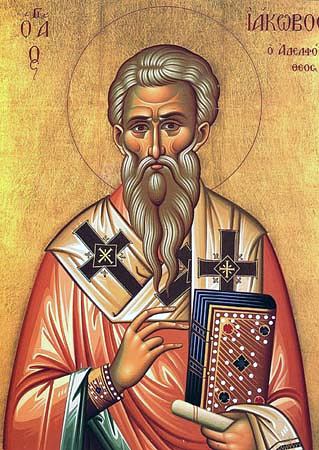
Some scholars doubt whether the Book of Acts is useful for constructing the first thirty years of the church. Still, in the case of James’s role in the early church, Galatians and Acts confirm the picture of James as the leader of the Jewish Christians in Jerusalem as early as A.D. 50 and as late as A.D. 57. But the name James (Ἰάκωβος, Jacob) is very common in the first century, and the author does not explicitly call himself the brother of Jesus in the letter. He is a “servant of God and the Lord Jesus Christ” in verse one rather than “James the Just, Brother of Our Lord Jesus Christ.”

Several traditions describe James as the first “bishop” of Jerusalem, although the use of that title in Eusebius (Hist. Eccl. 4.5.1-4) is anachronistic. An additional complication is that there are a bewildering number of apocryphal stories about James the Just and his leadership of the Jerusalem church. Some of these may contain historical memories of James, but they are buried in layers of polemic legend. Unfortunately, they are not much help in either identifying the author of James or developing a profile for the “historical James.”

The letter of James is sometimes seen as a response to the growing dominance of Pauline theology in the early church. Robert Wall recently suggested James is a second-century pseudepigrapha added to the canon to balance Paul’s theology. (Nienhuis and Wall, Reading the Epistles of James, Peter, John & Jude as Scripture, Eerdmans, 2013; read my review of the book here). He points out the collection of James, Peter, John, and Jude contains letters from the “Pillars of the Church” and is framed with two letters from the brothers of Jesus. He, therefore, suggests James is a kind of introduction to a “pillars” collection developed in the second century to balance the Paul collection.

Challenges to the Traditional View

This traditional view that Jesus’ brother wrote the Book of James has been challenged for a number of reasons in modern scholarship. Most recently, Dale Allison’s magisterial commentary on James in the ICC series weighs the evidence and concludes James is likely not the author. He points out there is there is no clear knowledge of James before the time of Origen (13). In order to evaluate this claim, Allison surveys many of the alleged allusions to James in early Christian literature, especially in Shepherd of Hermas. He concludes that “informed opinion is dramatically divided over the meaning of these parallels” (22). For some, it is obvious James used Shepherd of Hermas (therefore, not historical James and a later date for the book). For others, James was the inspiration for Hermas (implying an earlier date and maybe the historical James).

Allison also points out that the letter of James seems to misunderstand the theology of Paul (20), something which would be remarkable given the contact between Paul and James according to both Acts and Galatians. This is a good point, but it seems to me to argue against a later date since a writer living in A.D. 150 is less likely to misunderstand Paul than one living a hundred years earlier. The later writer would have all of Paul’s letters available to him and knowledge of the controversial nature of Paul’s theology in the first decades of the church. A misunderstanding is more understandable if James was written before Paul wrote Galatians or Romans. On the other hand, one could argue that a later writer deliberately misrepresented Paul to argue against him, creating a straw man argument.

On the other hand, Karen Jobes points to the use of Q (rather than the canonical gospels) as evidence of an early date (Letters to the Church, 159). Q refers to the sources used by both Matthew and Luke. If James can be shown to use Q, then perhaps this is evidence for an earlier date, before the canonical Gospels were written and circulated.

I believe the letter is the best representative of Jewish Christianity in the New Testament. While I fully understand there were Jewish Christians in Jerusalem well into the third and fourth centuries, the Christian community was almost entirely Jewish until Paul’s missionary activity in the late 40s. The letter of James “fits” the historical context of Acts 1-12 better than the second century.

How would reading James as coming from the leader of the Jerusalem church writing before Acts 15 affect our understanding of the letter?


Bibliography: Dale C. Allison Jr., A Critical and Exegetical Commentary on The Epistle of James (ICC; London: Bloomsbury, 2013).