Hebrews 6:1-3 – Leaving Elementary Teachings Behind

Open BibleThe context of the notoriously difficult “falling away” passing in Hebrews 6:4 is critically important.  In Hebrews 6:1-3 the author of Hebrews implies his readers are immature and have failed to grow at an expected pace. They need to “build again” on the foundation and re-learn the basics of the faith. In all of the Jewish Christian literature, there is a struggle to integration Judaism and Christianity. How much of the “old covenant” ought to be brought over to the new faith?  Hebrews 6:1-3 lists six foundational items (three pairs), all of which fit into the Jewish Christian world of the original authors, but need to be considered in the light of the New Covenant.

Repentance from Sin. Both Peter (Acts 2:38) and Paul (Acts 17:30-31, 26:20) preach repentance from sin in the book of Acts. Although turning to God is turning away from sin, the phrase “acts which lead to death” is unique to Hebrews 6:1. It is similar to James 2:17, “dead faith.” The original readers of Hebrews were not pagans converted from a sinful life, but faithful Jews who may have been (from an Old Covenant perspective), not all that sinful. The emphasis is on unproductive works vs. faith. So what exactly needs to be confessed and repented of when one comes to Christ? Perhaps the readers are overly concerned with outlining the exact nature of that repentance rather than repenting and then maturing!

Faith in God. Perhaps this is simply the natural partner of “works which lead to death,” the active sense of repentance. Since the audience is Jewish, it is unlikely that they worshiped idols.  The acts that lead to death and faith in God have to do with their participation in salvation, two sides of the same coin.

Instruction on Baptisms. The word “teaching” here may be an introduction to the final four items since they are all under the heading of “teaching.” This is a fairly difficult exegetical problem; the noun didach'” was used at the end of the first century of a body of instruction on these sorts of things (Didache, for example). That the noun for baptism is plural is a strong indication the readers were still practicing Jewish ceremonial washings in mikvoth.  If this is so, then either this is evidence Jews in Rome practiced ritual purity at a much higher level than we might have thought, or that the book of Hebrews was sent to Jerusalem, where there is clear evidence of mikvoth and ritual washing. In either event, plural “baptisms” likely does not refer to Christian baptism as we understand it, an “initiation ritual.”

Laying on of Hands. Like baptisms, it is tempting to read this in terms of later Christian practice, but “laying on of hands” was practiced in Judaism before it was taken over by Christians (Gen 48:14, Num 27:15-23, Deut 34:9). Since this is paired with baptisms, it is possible that laying on of hands was associated with the beginning of Christian life in the Jewish churches (Cf. Acts 8:16-17, 19:5-7).

Resurrection of the Dead. The final pair in this list are not practices but doctrines which were subject to strong (and perhaps emotional) debates among first century Jews.  One only needs to recall the division between Sadducees and Pharisees to know that the resurrection was a controversial issue (both for Jesus, Mt 22:23-33) and Paul, Acts 23:6).

Eternal Judgment.  A related theological problem in first century Judaism was the final judgment.  If there is a resurrection in the future, what will happen to those who are raised from the dead and condemned?  Is there “eternal torment”?  There are a number of texts from the Second Temple period which describe eternal torment of the unrighteous dead.  2 Enoch and 3 Enoch, for example, seem to indicate that at least some Jews of the first century did think that the dead would face eternal (and sometimes ironic) punishment.

The author does not say these “foundational items” are unimportant, but that these ought to be settled by now to that the readers are ready to move on to more mature doctrines. The “deeper” things in this case is next section of Hebrews, the teaching on Melchizedek and the Tabernacle.  The readers are fretting over foundational issues (who is in/out, details of theology which are not critical), and they are therefore unprepared for the difficulty of the argument which he is about to make.

But more important for the writer of Hebrews, the readers are unprepared for the possibility of persecution. If they have not progressed beyond the first things of the faith, will they be willing and able to endure physical persecution in the near future? Are the mature enough to continue in their faith in Jesus?

It is fairly easy to draw some analogies to Christian maturity in the western church. Although there are some large and wealthy churches, it is possible most members of those congregations have not moved much beyond the basics (an initiation ritual and when to stand for worship, basic teachings or what political party to support). Just as for the audience of Hebrews, when persecution comes, these will not be enough to ensure loyalty to Jesus Christ.
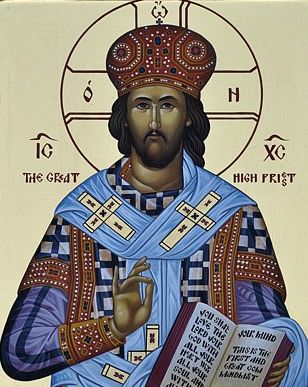


Hebrews 5:1-10 – The Great High Priesthood

In my last post on Hebrews I looked at Hebrews 4 as a part of the author’s argument that Jesus is superior to Moses and the priesthood of the Hebrew Bible.  This is the theme which will continue through chapter 10.  In fact the book of Hebrews is interested in Jesus as a priest more than any other book in the New Testament.  Jesus is called a priest and high priest only in this letter.  Since the argument of the next few chapters is based on the idea that Jesus is a priest in the order of Melchizedek, it is critically important to understand what these offices meant in the first century.

Two words of caution here.  First, the high priesthood of Jesus is based on the ideal forms found in the Bible, not in the high priesthood as it actually functioned in the first century.  By way of analogy, we could study the office of president of the United States as it is described in the constitution, or by the way various presidents have functioned as president over the more than two centuries.  James Buchanan, for example, usually is ranked at the bottom of the list of presidents by historians, mostly for his handling of the issues which erupted into the Civil War.

We would not, therefore, want to describe the office of president using Buchanan as our example!  In the same way, the high priests who held office in the first century were politically motivated and not particularly good examples of the way a priest ought to behave in his office. What is remarkable is that the book of Hebrews does not condemn the current High Priest as corrupt, nor does he say anything negative about the worship of the Temple other than it has been completed in Jesus.

Secondly, the word “priest” has connotations in English which are not present in the function of a Jewish priest.  We are not describing a Catholic or Orthodox priest, but rather the Jewish priest.  This modern sense of the word is not particularly helpful in understanding the priesthood in the Hebrew Bible.  The priest in the Jewish Temple was the mediator between God and man. As such, the office of priest foreshadowed the ministry of Jesus who was provides access to the throne of God for those who have entered into new life through him.

The original intention of a priest in the Hebrew Bible was to be an intermediary between God and Man.  The High Priest chosen to enter the Holy of Holies on the Day of Atonement.  He represented the nation and did his duty on that Day on behalf of the nation.  If the High Priest performed his function right, then the sin of the nation was covered.  Since he was a fallible human, there was always the possibility that the atonement was imperfect.

Not so with Jesus as the ultimate High Priest.  He is the perfect intermediary between God and man because (Hebrews argues) he was true human – untainted by sin.  Therefore he preformed his duties in the real sanctuary properly, providing real atonement to the whole world, once and for all!

Hebrews 5:5-10 – Why Does Hebrews Call Jesus a Priest?

Like human priests, Christ was divinely appointed to his office (5:5-6). The writer will deal with his points in reverse order, dealing first with the appointment of Jesus to the office of High Priest. The writer cites two Psalms which he already used in the first chapter.  The first quote is from Psalm 2:7, and emphasizes the fact that God called Jesus to the role of High Priest as he called him his Son. The second quote is from Psalm 110, and calls Jesus a priest forever in the order of Melchizedek, the mysterious “priest of the most high God” in Genesis 14.

Melchizedek was a priest of the true God in Palestine at the time of Abraham, nothing is known of him from scripture other than Abraham’s tithe after the victory that liberated Sodom and his nephew Lot. More will be said about Melchizedek in chapter 7, for now it is sufficient to say that Melchizedek is a true priest of God, before the Law, and for that reason Christ can be said to be a true priest even though he is not directly in the priestly line.

Because Christ fully human, the writer of Hebrews says he was able to fully sympathize with our struggles (5:7-10).  The humanity of Christ was mentioned in an earlier passage, making him a sympathetic high priest but now that humanity is shown to be the same humanity as ours because he submitted to the father.

Jesus PassionIn fact, Jesus “offered up prayers and petitions with loud cries and tears to the one who could save him from death, and he was heard because of his reverent submission.”  “Offered” is the same word as the function of the high priest in verse one, the offering of sacrifices.  Here it is “prayers and petitions. This verse is may related to the prayers in the garden, when Jesus prayed to the Lord concerning the death he was about to endure.

Since the wording is similar to Psalm 22:24, some think that this refers to the words spoken on the Cross.  This fits better with the “loud cries” and tears, since the prayers in the Garden were not reported in this way.

Several theological issues converge here, concerning Jesus’ reason for even asking God to take the cup from his hand, and whether or not he really meant to have his death postponed. Many have pointed out that Jesus was probably praying for strength to endure the tortures awaiting him before the Cross. Whatever the case, it is also important to understand that Jesus was submitting himself to the will of God, just as every other human being must do, he fervently prayed that God’s will be done, not his own will; he made his will conform to that of the Father.

It is this submission to the will of God the writer of Hebrews wants to call to our attention. Jesus was “like us” to the point that he cried out to God. But rather than complaining about his suffering or begging for mercy, he humbly submitted to his Father’s will in all things.

Unfortunately the image of Jesus as a faithful high priest is presented in popular preaching and teaching only as a personal encouragement, something like “Jesus suffered this way too so stop complaining.” The theologically rich image of Jesus as a high priest should not be so quickly turned into pep-talk for dealing with normal daily stress. Does the writer of Hebrews think the image of Jesus as a High Priest should be used like this?

Hebrews 4:14-16 – Jesus as High Priest

The book of Hebrews emphasizes the priesthood of Jesus more than any other book in the New Testament. In fact, much of the argument of Hebrews 5-10 is based on Jesus as the High Priest. Two words of caution before discussing Jesus as a High Priest.

high priestFirst, the “high priesthood of Jesus” is based on the ideal form of priest found in the Hebrew Bible, not in the high priesthood as it actually functioned in the first century.  By the first century, the High Priest more a political figure that a religious leader.  Control of the temple and the priesthood gave the office a great deal of power, and this power usually led to great wealth. It is unlikely, however, that the writer of Hebrews has this sort of power in mind.  He consistently looks to the idea image (“the shadow”) from the Hebrew Bible in order to describe the “substance” of Jesus.

By way of analogy, we could study the office of president of the United States as it is described in the constitution, or by the way various presidents have functioned as president over the more than two centuries.  James Buchanan, for example, usually is ranked at the bottom of the list of presidents by historians, mostly for his handling of the issues which erupted into the Civil War. We would not, therefore, want to describe the office of president using Buchanan as our example!

In the same way, the high priests who held office in the first century were politically motivated and not particularly good examples of the way a priest ought to behave in his office. What is remarkable is that the book of Hebrews does not condemn the current High Priest as corrupt, nor does he say anything negative about the worship of the Temple other than it has been completed in Jesus.

Second, the word “priest” has connotations in English which are not present in the function of a Jewish priest.  We are not describing a Catholic or Orthodox priest, but rather the Jewish priest.  This modern sense of the word is not particularly helpful in understanding the priesthood in the Hebrew Bible.  The priest in the Jewish Temple was the mediator between God and man. As such, the office of priest foreshadowed the ministry of Jesus who was provides access to the throne of God for those who have entered into new life through him.

But Jesus is not just the High Priest, but the “great High Priest.” This was a title give to the High Priest Simon in 1 Maccabees (13:42, 14:27). This Simon was one of the founders of the Hasmonean dynasty and the first to take the title of both King and Great High Priest. His first year in power was “the yoke of the Gentiles was removed from Israel” (c. 142 B.C., 1 Macc 13:41). This combination of priest and king was an attempt to consolidate power into the one “office” in Maccabean revival of the kingdom in Judah.

How does the author of Hebrews distinguish Jesus as a high priest from the politically powerful priests of the first century?

Hebrews 3:7-19 – An Exhortation to Righteousness

This exhortation is based upon the experience of Israel as described in Psalm 95. The thing to avoid is a “sinful, unbelieving heart.  Heart in this case is not the emotions but rather the place of the will.  A “sinful and unbelieving heart” would imply that the person is unsaved.   The writer does not tolerate any within the congregation that are not believers, those persons are under God’s judgement and they are the ones that he is especially speaking to, in order that they do not bring shame to the church by recanting a faith they never shared.

If the unbelievers are Jews that “fall away” by returning to Judaism, how can the writer say that they are turning away from the living God?  The Jews do recognize God.  The point is that Judaism no longer presents the true revelation from God, it is inferior to the revelation that comes through Jesus in “these last days” (from 1:1-3).

A possible solution to the possibility of unbelief in the community of believers is that the “encourage each other daily.” The “daily” exhortation underscores the meaning of the word, this is an active effort on the part of the community of believers to help each other with their Christian walk.  There is a positive aspect to this word (encouragement), but also a negative aspect, a pushing toward spiritual excellence which may take the form of a shove!

In the modern church we tend to think of the pastor as a professional exhorter, as long as he doesn’t get too personal or call during dinner or the football game to exhort us.  Half an hour on Sunday is fine for most people (just don’t mention “sin”).  This text says that the community ought to encourage the community.  Mutual encouragement, but also exhortation – a sort of positive peer-pressure that encourages growth and development of a deeper relationship with God and each other.

The writer of Hebrews describes a whole church talking to each other and trying to keep each other from sin, a network of accountability that is virtually unknown in the modern church.

What are the people to encourage?  That we not be deceived by sin and harden our hearts. Sin is deceitful, it is seductive.  Satan does not appear as a slobbering evil dragon demanding your soul, he appears as an angel of light, a really nice guy with a good plan to help humanity, or maybe to help your family.  He takes the truth and twists it into a sin that looks pretty good!  Sin is a subtle deception, those are the best kind.

But if your community of believers is daily encouraging you not to harden your heart, it is much easier to do the right thing and avoid sin.  I am not sure modern Christian communities are very good at this encouragement.  On the one hand, they can become very legalistic and judgmental, even demanding of their members (to the point of being more like a cult than the Body of Christ).  On the other hand, some churches are so lax in this sort encouragement that there is no call to deal with the flesh, nor any preaching on sin in the life of the believer.  As they say these days, “it’s all good.”

It is not all good, it never was.  Believers need to return to this sort of mutual encouragement for the building up of the Body of Christ. Does is local church always an community? How might this section of Hebrews be used to transform personal relationships?