In a previous post, I tracked the shift in Parables studies away from the allegorical methods of the medieval church to the “one point per parable” method of Adolf Jülicher. in the next several posts I want to talk about a few other scholars who developed Jülicher’s ideas in the twentieth century.
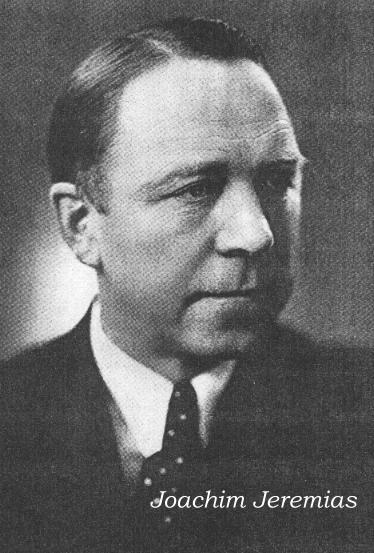 Jeremias’ The Parables of Jesus is perhaps the most influential work since Jülicher. He adapts Dodd’s method by fully applying the methods of form criticism. Like Jülicher, Jeremias rejects allegory, but he also rejects Jülicher’s own reworking of Jesus as an “apostle of progress.” Jeremias goal, in contrast, was to “hear the voice of Jesus” by developing a set of tools which can liberate that voice from the literary context in which it has been preserved (9).
Jeremias creates a methodology for detecting the “transformation” of the parables from their original form to the form found in the gospels. These are areas in which he thought the early church had adapted the parables. Some are certain, such as the translation of Jesus’ words from Aramaic into Greek or “representational changes” as the story was re-cast in a non-Palestinian culture, but others are suspect.
Jeremias sees later churches adding conclusions and introductions to the parables and placing the parable in a new contexts to better fit the Gospel author’s theological tendency. Any “moralizing” was an example of the hortatory use of the parable in the early church. Any allegorizing was an influence of the Sitz im Leben (life-setting) of the early church, such as the “delay of the parousia” in the parable of the Ten Virgins (61). Jeremias accepted the realized eschatology of Dodd, but interpreted the parables as applicable to Jesus’ ministry, especially his ministry to the poor.
While fully accepting Jülicher’s view of the parable as similitude rather than metaphor, Jeremias is not free from allegorical interpretations. Jeremias describes the Parable of the Banquet in Luke 14:7-15 as an allegory of salvation. The characters of the Prodigal Son story represent other referents outside of the narrative world, such as the father as God. The wicked husbandmen was allegorized by the early church, but the idea that the vineyard is Israel comes from Isaiah 5. This allegorical symbolism is “unique in the parables of Jesus” (55). In the parable of the Ten Virgins, the oil represents repentance (132).
Like Dodd, the kingdom in the parables is fully realized in the ministry of Jesus. The “eschatological overflowing of divine fullness” is to be found in the person of Jesus and in the salvation he is bringing into the world (92-93). That there is in fact a coming crisis is clear from the parables, but that crisis is a judgment on the “nation rushing upon its own destruction, and more especially on its leaders, theologians and priests” (126). In this “demand for decision,” Jeremias anticipate some later developments in parables research in his discussion of the existential and eschatological motifs in the parables.
I remain unconvinced that there is much hope of discovering the church-setting of the Parables. Why Matthew preserved one parable and Luke preserved another is a matter of the author’s decision and it is difficult (if not impossible) to decide what motivated that decision in some community to which the gospel is addressed.
Jeremias is still an important work since was among the first to take the historical setting of Jesus’ parables seriously. The first step in his method was to establish the parable in the world of first-century Judaism. This is something that still remains the first step in accurately reading a parable.
Bibliography: Joachim Jeremias, The Parables of Jesus. Tr.S. H. Hooke. New York: Charles Scribner’s Sons, 1955.
I like that P. Long mentioned, “Jeremias is still an important work since was among the first to take the historical setting of Jesus’ parables seriously.” I agree that it is important that in order to accurately read the parables we need to understand the historical seeing of Jesus. In Simply Jesus, N.T. Wright says, “They were stories designed to tease, to clothe the shocking and revolutionary message of God’s kingdom in garb that left the hearers wondering, trying to think it out, never quite able(until near the end) to pin Jesus down” (87). In Luke 8, the disciples even had to ask Jesus what certain parables meant. My point is that it is important in order to being to understand Jesus’ parables we need to look the historical setting and what is was like when Jesus taught the parables. Like Naomi mentioned above I am glad that Julicher thought that parables were similitudes not allegories (Strauss, 447).
This way of thinking moves in a direction closer to what I believe to be true but seems to still try to create a “system” approach to reading the parables that I don’t think needs to exist. Reading the parables with a different lens than the other parts of the same book doesn’t seem to be the most accurate way to interpret the text. Jeremiah does establish an accurate first step in reading the parable but this is not a complete way to read the text. The reader is still left with problems in regards to application and interpretation.
I just want to see the Bibliography.