Israel 2013, Day 4 – Around the Zion Gate

I am continuing day 4 in this post. We are checking out of the Dan Hotel in about an hour and heading north, by this evening we will be at Ma’agan in Galilee. This is a beautiful resort on the Sea of Galilee, and has free wi-fi in the lobby. I am sure it is more reliable that the Dan Hotel!
20130504-064607.jpg

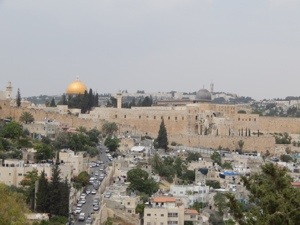
From Caiaphas’ backyard?

After our hike in the Kidron, we had the bus drop us off near the Zion Gate. my intention was to visit David’s Tomb and the Upper Room (the Cenacle). This is the first time since 2005 i have visited these sites and much has changed! The Tomb of David is now divided, with separate places for men and women, and I am fairly certain that the whole place is re-designed. Locating the Upper Room was a bit of a challenge, there is no signage marking the place (or I completely missed it). If there was not another group in the place, I probably would have missed it entirely. This was a short visit, but I did talk a bit about Peter’s sermon in Acts 2 which refers to the Tomb. Nether the Tomb nor the present Upper room are authentic, bit it is likely they were in these approximate locations in he first century.

I then took the group through Zion Gate, which is always an adventure to get through since it still allows cars to pass. The gate itself is marked with bullet holes from the Six Day War. The Jewish Quarter was heavily damaged in that war, but that allowed archaeologists to survey the area before it was rebuilt.

A walk through the Jewish Quarter on a Friday afternoon was refreshing change fom the Christian Quarter. it was quiet and clean, and most of all, not really crowded.  Just as we arrived there was a bit of thunder as cooler weather moved in. After looking at the Cardo, the group broke up to explore. Some visited the shops, there are so many good art and jewelry shops in that area of the city. Scott Spooner, Kyle Vegh and I walked down the the place where the Roman Cardo is visible and around the corner to the “broad wall”, usually identified with Hezekiah’s expansion of the city after the fall of Samaria in 722 B.C.

I had an excellent Turkish Coffee at a kiosk near Hezekiah’s wall. I do not recall the name of the place, it was a “to go” shop (I recommend it!). We walked around to Hurvah Plaza and watched the people for a half-hour and chatted about the variety of Israelis living in that part of the city. Like the variety of Christians in the Holy Sepulcher, there is a bewildering variation of practice among the people passing through that Plaza.

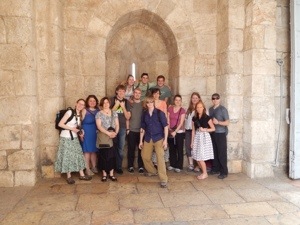
Walking from the Zion Gate to the Church of Saint Peter Gallicantu, we tried to peek into the garden where Oscar Schindler is buried, but the site is only open in the morning. I guess I have to be satisfied with a photo of the gate.

Church of Saint Peter Gallicantu is the traditional site where Peter denied Jesus. The church is built over the home of a wealthy family, traditionally identfied as Caiaphas, the high priest who questioned Jesus. Unlike my only other visit to this church, it was very quiet, almost deserted! We were the only group there for most of our visit. The highlight is the deep cistern in which Jesus was held after his arrest and interview with Caiaphas, but before his more public trial (John 18:1-11). Whether this is the location or not, it is a great place to read John 18 and think about Peter’s denial of Jesus. It is always shocking to realize that Peter swore to die with Jesus and tried to defend him in the Garden only to deny him a few hours later in Caiaphas’ courtyard.

There is a decent amount archaeology to see outside the church, but most is not well marked and there is an intimidating fence to keep visitors off the first century road and stairs. The church also has a model of Jerusalem during the Byzantine period. This is nothing like the quality of the model at the Israel museum, but it does show the major Christian sites. Standing around this map was excellent time trying to identify the locations we have visited, seem like everyone was able to point out major landmarks. Becca noticed that by the Byzantine period, the Gallicantu church was inside the walls, so we started to point out all of the differences between the current Old City and the Byzantine. Shayna saw that the Jaffa Gate was a bit off, then Scott Shaw pulled the ESV Study Bible up on his iPad and we compared the city at the time of David to the time of Jesus, etc. I think that this group of students could probably negotiate their way around the Old City quite well by this point.

On the bus we drove past the Valley of Hinnom, which I would really like to hike some time. The Valley is not very high on most tourist’s list of things to see, but there are a number of minor locations that would interest me.

I noticed that there were a few people dozing on the bus, I worked this group pretty hard today. Tomorrow we drive up to Caesarea, one of my favorite locations in Israel.
20130504-064852.jpg

Israel 2013, Day 4 – Down The Mount of Olives and Up the Kidron

After writing most of this post, I realized that we saw a lot today, I amazed that we could fit all this into a single day. This might be the difference between traveling with college students rather than older adults, but I will say I saw some tired people on the bus ride back to the hotel! In fact, there is so much here I will split this post into two, just to make it a more manageable read.

20130503-181129.jpg

On the Mount of Olives

We started the day at the top of the Mount of Olives. As always, the drop off for the walk down was crowded, lots of guides trying to jockey for position along the wall so their group can get that “perfect picture.” Since we have already walked throughout the Old City, the group asked really good questions, pointing out the places they have seen and trying to get their minds around the geography of the city. I had the impression that there were less vendors this year, I was not approached once. Maybe I just looked surely.

From the top of the Mount of Olives we walked down to Dominus Flevit, a small church at the traditional site of Jesus weeping over Jerusalem. We read from Luke 19 and talked about what the crowds, especially the disciples, thought Jesus was going to do when he went up to the temple. One of the highlights of this church is the cave near the entrance with a collection of ossuaries. This indicates that the Jewish tradition of burying the dead on the Mount of Olives goes back to the first century.

The garden of Gethsemane was packed with tourists, as usual. we arrived at the same moment a Russian Orthodox group was leaving the Church of Mary Magdalene, so we were somehow lost in the crowd. My first visit in 2005 you could still walk between the trees, but there are far too many people for that now. Inside the Church of All Nations there are some renovations going, the center arches are being refurbished so there is a large scaffold in the center of the church. They did a nice job disguising the work, but it was not as solemn as usual.

After waking down the Mount of Olives, we were near the bottom of the Kidron Valley, so I marched across the street to walk down into the valley and see Absalom’s Tomb and the other monuments. I have only done this once before (in 2007) and did not think too much of it at the time. The walk then was not conducive to tourists, and it was full of broken bottles and trash. The Parks Authority has done a wonderful job cleaning the area and building excellent stairs down past the graves to the monuments. I should explain that these are all Hasmonean tombs and have nothing to do with Absalom or Pharaoh’s daughter, those are the traditional names.

Another new feature is a stairway up the other side of the valley that end a short distance from the City of David. It would be possible to have the bus drop a group across the street from the Church of All Nations and hike down the Kidron, up the other side to the City of David, then down the Canaanite tunnels to the pool of Siloam, the up the Herodian steps and sewer tunnels to the Davidson Museum to tour the excavations there at the Ophel. That might make for a long day, but quite exciting to me. Maybe on the 2015 tour?

I will be posting a bit more from this long day a bit later. Stay tuned!

Israel 2013, Day 3 – The Garden Tomb vs. The Holy Sepulchre

Thanks for following along as Grace Bible College tours Israel and Jordan. The Dan Hotel is absolutely packed and there is almost no bandwidth for the free Internet connection in the evenings. I am therefore posting this the next morning, hopefully that is not a problem for the reader. I will get more pictures posted when I get to Galilee tomorrow night.

Everyone is healthy and happy, although it is still quite warm. I told the group that everything in Jerusalem is uphill, and they all agree with me now. Kodie Palmer thinks he can find his way around the old city now, so I am thinking of chilling by the pool and letting him guide the group…maybe not.

Day three began with a tour of The Garden Tomb. There are basically two suggested sites for the crucifixion and burial of Jesus. For most of Christianity, the Holy Sepulture is the place venerated by virtually everyone, except Protestants. The Garden Tomb was first suggested by Gordon in the late 19th century based on the fact there is a rocky face in an escarpment not far from the Damascus Gate (outside the city) and a nearby garden with a tomb. There seems to be evidence that the garden is first century, although I find it hard to believe that the “skull” was visible 2000 years ago. Nevertheless the Garden Tomb is an excellent place to think about the resurrection of Jesus, especially since our Garden Tomb host pointed out that the place is not the main point at all, but the person of Jesus. Our guided made this point by simply observing that the disciples themselves never return to the tomb in he gospel stories. Since Jesus is alive, the place of the tomb is not really of importance.

After reading the resurrection story in John and singing Amazing Grace, we set out for the Holy Sepulcher. I am not sure the contrast could have been more clear for the students. I did not check the liturgical calendar for non-Roman Catholic Churches, it is about the time of Easter for several of the groups which share the Holy Sepulcher. The pace was packed! The Coptic Chapel is usually ignored, but this week there was a constant flow of Egyptians. Our hotel has a huge group of Abyssinian Christians, and one member of our group met a Chaldean Christian. While the church was noisy, and the Christians generally rude (by polite American standards), it was quite amazing to see that range of Christian practice in a single place.

From the spectacle of the Church, we moved on to one of the more amazing archaeological sites in Jerusalem, The City of David. we chose to stick to the Canaanite “dry” tunnels, which was a good choice since there were several school groups going through Hezekiah’s Tunnel. The water was not that deep, but the idea of being in a narrow, pitch black tunnel with cold water knee deep and two hundred screaming kids is not my idea of a good time!

They have done a bit of work on the Shiloah Pool (pool of Siloam in the NT), as much as can be done without getting into the Orthodox Monestary’s back yard. We were able to see the end of the sewer used by the Zealots when Jerusalem fell in AD 70, and ther is quite a bit of Herodian stone exposed. I will write more on this later when I am not as presses for time.

The best improvement is a shuttle service back to either the City of David entrance or the Dung Gate. Best five shekels you will spend.

Tomorrow, the Mount of Olives.

Israel Trip, Day 2 – Walking around Jerusalem

For our first full day in Israel we walked around thenOld City and visited some familiar cites, and had a few surprises. It is quite warm this week, highs in the low 90s. Everyone did a good job with hydration, but they were tired campers by the end of the day.

I started the group with Rampart Walk on the north side of the Old City. The Ramparts adage to the 16th century, built by Suliman the Magnificent. This is a chance to talk about the sections of the Old City and get some orientation for the sites we will see later in the tour. There was a bit of a disappointing end, however. I usually take the group off the Ramparts at the Damascus Gate and go through the Hadrian era (post A.D. 135) and finish the walk. But the Hadrian-era gate is closed! The guy at the ticket both neglected to mention that fact. I am not sure who is in charge of the Hadrian gate, but it strikes me a bit dodgy. I would love the National Parks to step in and get the Ramparts improved, including the Hadrian Era Damascus Gate.

Instead of walking around to the Lion’s Gate on the Ramparts, we back-tracked the Via Delarosa to the pool of Bethesda and Saint Anne’s. the place was quite packed, but a large group singing in that church is rather nice. The lower levels were open, which never has been the case when I have visited before. After looking around the church, we went through the excavations at the pools. I stopped in the Roman Cistern to talk about the biblical significance of the pool of Bethesda, more or less to get out of the sun. There was a large group in the spot I usually use for the whole hour we were there.

Coming back along the Via Delarosa, we went into the Church of the Flaggelation, one of the stations of the Cross. This is the traditional site were Jesus was whipped not the way to the cross. I have not been inside this particular site before, and did not actually enter the church, but there are a number of interesting inscriptions and other items found in the church grounds. These are more or less decorative, and there are nor explanations given. Since it was about noon, we did not have much time to explore.

20130501-211535.jpg

At the Jaffa Gate

From there we visited Western Wall. this must have been a field trip day for the school. There were a million little kids in matching shirts, following exasperated teachers. Every once in a while they would chant patriotic songs and make noise. The older ones were more interested in the cell phones than the tour. The plaza was very busy, although we were able to find a place at the to pray.

We ate Lunch at the top of the stairs overlooking the plaza. I had what assume is the first of many falafels. Several people had the schwarma, it was big enough that two of the college guys could not finish theirs. (If Ben Stout comes home with half a schwarma in his bag, it is not my fault!)

After lunch we went to the Davidson Museum and the Southern Wall excavations. I always find this site to be one of the best presentations of the city of Jerusalem in the first century. The main part of the site is the same as my last couple of visits, but I was able to walk down to the Ophel sections. These are the most controversial of the excavations, especially with the claim that parts date to the 10th century. Seems to be that the fortifications can be described as “destroyed by Babylon.” I wonder if there will ever be a time that connects the City of David excavations with these at the Southern Walls, probably nor wit the very busy street separating the two, but I suppose it is possible.

We headed back to the hotel about five, Jerusalem traffic is always bad, it was terrible today. We will start the day with communion at the Garden Tomb, then the Christian Quarter in the Old City.


Israel 2013, Day 1 – We Have Left, On a Jet Plane

We had a great day of travel with no hassles from security very few problems along the way. Our flights were mostly full, but left on time and were quite smooth. I even managed to sleep some this time. It is now almost 9pm, so I thought I had better get a quick post up before I get too groggy to write.

It was very warm in Tel Aviv, 95 degrees when we landed. They have a new system for visas at Ben Gurion airport. Instead of a stamp in your passport, they scan the passport and issue a credit card sized slip of paper that has your passport pic and a bar code, with the dates of your entry. We all got through passport control quickly, so either we looked like a trustworthy lot, or this new system speeds things up considerably.

The bus ride to the Dan Hotel was uneventful. The drive from the airport to Mount Scopus takes about an hour through busy afternoon traffic. I stayed at the Dan Hotel in January of 2012, and I do recommend it. It is a short walk to the light rail if you want to go into the Old City at night or Ben Yehuda street. I am not sure I would recommend taking a large group (skipping the tour bus), but for a couple of people it is a great way to get around.

The group seems to be getting along great. Several were good friends to start with, others just met this week. Dinner was a nice buffet, although Kyle was not happy when he found out the beef he ate was in fact beef tongue. The desert bar got a half-dozen thumbs up, I mostly drowned my sorrows in a plate of hummus and veggies.

Tomorrow we head to the Old City, starting with the rampart walk around the north side of the city, from Jaffa gate to the Damascus Gate. We will visit the Western Wall and the Davidison museum at the Southern Wall excavations. As I have said before, that is always a highlight for me because of the quality reconstruction of the Roman era streets, the Arch, and the Temple steps. If you want to “walked where Jesus walked,” then the Southern Wall excavations are the place to visit.

More tomorrow….