Book Review: Justin W. Bass, The Bedrock of Christianity

Bass, Justin W.  The Bedrock of Christianity: The Unalterable Facts of Jesus’ Death and Resurrection. Bellingham, Wash.: Lexham Press, 2020. 238 pp.; Pb.  $13.99  Link to Lexham Press    Link to Logos Bible Software

In this short apologetic text, Justin Bass seeks to establish the basic facts of Christianity. Alluding to the introduction to John Meier’s historical Jesus study, The Marginal Jew, Bass imagines a meeting during which Protestants, Catholics, Jews, atheists and agnostics scholars evaluate evidence and determine what basic facts about Christianity everyone can agree on. In his introductory chapter he disregards the mythicist position represented by Richard Carrier. He cites Bart Ehrman description of the view as “foolish,” compares the “handful of mythicist hecklers” to Holocaust deniers (p. 5-7).

In the first chapter, Bass outlines his historical method. Following Bart Ehrman, he says historians want early dating, multiple eyewitnesses, corroboration of those eyewitnesses, and unbiased sources (p. 28). He then asks what we can know about Tiberius Caesar, the Jewish War, Socrates and John the Baptist using these four historical measures. In each case, scholars agree on a historical bedrock based on a variety of sources. With Tiberius, his reign is well known from four literary sources that date long after his death. Comparing this to what we can know about the apostle Paul, Bass argues scholars have an abundance of trustworthy sources for Paul’s life, especially compared to Tiberius and Socrates. However, Bass omits archaeology from his list. Hard evidence for the reign of Tiberius is abundant if archaeology, inscriptions, and numismatics (coins) are allowed as evidence. This kind of evidence is unavailable for characters in the New Testament.

The Apostle Paul is therefore Bass’s “Bedrock Eyewitness.” Chapter 2 sketches a biography of the apostle Paul drawing only on his epistles. He uses Acts for his chronology of Paul’s life, working backwards from Paul’s hearing before Gallio (A.D. 51/52; Acts 18:12-17). Having established that Paul is an early eyewitness, he presents his “Bedrock Source,” 1 Corinthians 15:3–7 (ch. 3). Bass argues this is a pre-Pauline creedal tradition delivered to Paul by the apostles (p. 74). He follows James Dunn who suggested the beginnings of this creedal statement may go back to the first few months after the resurrection (p. 82). But at the very least Paul must have received it during his brief visit to Jerusalem in A.D. 37 (Gal 1:18-19).

Having established the creedal statement in 1 Corinthians 15:3-7 constitutes early eyewitness evidence from multiple sources, Bass then examines the three key claims of the creed. First, the creed establishes the bedrock fact that Jesus was crucified: “Christ Died for our Sins and He was Buried” (ch. 3). After a short discussion of crucifixion in the Roman world, he draws together several texts from Paul’s early letters which demonstrate that Jesus was not just crucified, but that his crucifixion was “for our sins.” Bass argues these statements are based on the Suffering Servant in Isaiah 53 and he suggests  the historical Jesus may be the origin for the idea his death is in some ways like the servant of Isaiah 53. Here Bass goes to another tradition Paul received from the apostles, the inauguration of the Lord’s Supper in 1 Corinthians 11:24-25. Although he considers the crucifixion of Jesus under Pontius Pilate as a historical bedrock fact, he does not think the phrase “he was buried” can be counted as a bedrock fact. For Bass, it is likely Jesus was buried as recorded in the Gospels, but the evidence is not clear that someone named Joseph of Arimathea buried the body of Jesus.

The second element of the creed in 1 Corinthians 15:3-7 is the claim Jesus was “raised on the third day.” Bass shows that there were no traditions drawn from the Hebrew Bible to indicate a belief in the first century that the Messiah would be die and rise from the dead. Although there is a hint of resurrection in Daniel 12:2-3 and 2 Maccabees 7:9-14, a dying messiah is unknown. Bass argues there are three innovations from the earliest Christ followers. The first innovation is a positive interpretation of a crucified Messiah. There is no other crucifixion in the Greco Roman world seen in a positive light. The second innovation is the claim this crucified Messiah had been raised from the dead. This claim is unanticipated in Second Temple period Judaism. Third, that this crucified Messiah who God raised from the dead is the divine Lord of the world is an unparalleled innovation. Here Bass cites another early Christian tradition passed along to the apostle Paul, 1 Corinthians 8:6. This is the almost shocking insertion of Jesus into the Jewish shema. Bass cites Larry Hurtado, “this worship of the risen/exalted Jesus comprises a radical new innovation in Jewish monotheistic religion” (129).  Bass is using the so-called criterion of dissimilarity used in historical Jesus studies. Essentially, this criterion argues that if something is different than the Judaism of the Second Temple period, it is more likely to be authentic. In this case, the crucifixion and resurrection of the Messiah is not something that a group of Jewish theologians would have created.

The third element of the creed is the list of post-resurrection appearances. That Jesus appeared to Peter, the Twelve, more than 500 at one time, and James is a wide range of witnesses. Bass recognizes that Paul has added himself to the list. He quotes skeptics Bart Ehrman and Paula Fredriksen as saying they might not know what Paul saw, but Paul believed he saw Jesus (p. 162). Bass argues Paul was not lying by using Paul’s “foolish speech” in 2 Corinthians 11:23-27. This speech lists various ways Paul has suffered for his preaching of the Gospel. If he was lying about the resurrection of Jesus, then his life after his Damascus Road experience is inexplicable. In the conclusion to his book, Bass cites E. P. Sanders, “That Jesus is followers (and later Paul) had resurrection experiences is in my judgment, a fact. What the reality was that gave rise to the experiences I do not know” (Historical Figure of Jesus, 279-80). Bass’s challenge to this agnostic view of the resurrection is to push past agnosticism and “give the risen Jesus welcome” (p. 207).

Paul’s suffering serves as a transition to the final piece of Bass’s argument, the fast rise of the Nazarenes. For Bass, it is difficult to account for not only the persistence of followers of Jesus from the days just after the crucifixion, but also the willingness of those followers to suffer and die for their faith in a resurrected messiah who is the Lord of the world. This is a common apologetic strategy, but it may fail because there are many other movements that encouraged martyrdom from their adherents, yet they were based on horrible distortions of the truth (Jim Jones and David Koresh, for example). This chapter includes sections on Christianity’s unique origins, continuing influences, and skeptics who have converted to Christianity throughout history. Similar to the willingness to die for one’s beliefs, someone might suggest Islam has had a similar influence on the world, and no one wants to argue Christianity has always had a positive influence. This strategy is typical in apologetic textbooks, but I’m not sure how it contributes to the bedrock of Christianity as defined in the first chapter of the book.

Bass often cites skeptical scholars who agree with him such as Bart Ehrman or Paula Fredriksen; even Crossan and Bultmann make a few appearances. This is a rhetorical strategy designed to show these are in fact “bedrock facts” of Christianity. The book is richly footnoted and includes an extensive bibliography which will point interested readers to more detailed studies. The book will reaffirm the beliefs of committed Christians and perhaps encourage Christians who have some doubts. I’m not sure it will convince skeptics, but that’s the nature of apologetics. Bass’s book supports the contention the bedrock of Christian faith is reasonably historical.

NB: Thanks to Lexham Press for kindly providing me with a review copy of this book. This did not influence my thoughts regarding the work.

Book Review: David Bomar, Journeys of the Apostle Paul

Bomar, David. Journeys of the Apostle Paul. Bellingham, Wash.: Lexham Press, 2019. 154 pp.; Hb.  $29.99  Link to Lexham Press

The essays in this volume are collected from a five-part series on Paul’s missionary journeys originally published in Bible Study Magazine, edited by David Bomar. After a brief section on the Paul’s Damascus (including two short essays on Acts 9:1-22), the book is divided into units based on the three missionary journeys and the trip to Rome.

Journeys of the Apostle PaulSince the front cover of the book puts Craig S. Keener at the head of the contributor list, it is disappointing to find only two brief contributions at the beginning and end of the book: “Who Was Saul of Tarsus?” And “Rome: To the Empire and Beyond.”  Keener suggests Paul was motivated to preserve his Jewish traditions by nationalistic zeal modeled by the Maccabees and Phinehas (Numbers  25:11). Keener explains why the book of Acts ends so abruptly by pointing out Luke’s narrative reaches a climax in Rome, but it also ends with a foretaste of the continuing mission to the nations.

Five essays on Paul’s ministry are scattered throughout the volume. First, Eckhard J. Schnabel “Paul the Missionary: Preaching to Everyone, Everywhere” (p. 46-49), including a chart of sixteen phases of Paul’s ministry suggested by Schnabel in his Early Christian Mission (IVP Academic 2004).

Caryn Reeder’s “Paul the Traveler: A Day’s Journey with Paul” (p. 61-61) Braves what it might have been like for Paul and his companions to travel 18 to 20 miles a day. As she points out, staying in an in was always dangerous; they were well known for lice, fleas, robbers and prostitution. During the second missionary journey put often stayed with members of the Christian community.

James W. Thompson’s “Paul the Pastor: Cultivating Faith, Nurturing the Church” touches on themes from his 2006 monograph, Pastoral Ministry according to Paul (Baker). For many of his churches, Paul focused on nurturing church is like a family. He considered the members of his church his children, and he took it upon himself to raise them in the faith.

Randolph Richards contributed a section to Rediscovering Paul (Second Edition, IVP Academic, 2017) on Paul’s letter writing, summarized here as “Paul the Writer: Spreading the Gospel through Everyday Letters” (p. 96-101). While admitting it is difficult to place into a timeline, he lists Galatians is the earliest letter in his chart of the Pauline letters (although the date range overlaps with 1-2 Thessalonians). He discusses letter writing as a collaborative effort, since most of Paul’s letters reflect the ministry team. The section briefly discuss is the process for writing letters, and there are illustrations of papyri documents (although not a letter, the editors chose to use p46 as one of the oldest New Testament manuscripts).

Brian M. Rapske distills his monograph Paul in Roman Custody (Eerdmans, 1994) int two pages, “Paul the Captive: Even in Chains, He Remained Christ’s Ambassador” (p. 131-35).  According to Rapske, “Imprisonment, far from being an interruption to or disqualification from ministry, was a true expression of it” (p. 132).

The book includes four essays each from Caryn A. Reeder, Joseph R. Dodson and Timothy Gombis. In addition to her essay on Paul the Traveler, “Who Were the Pharisees,” “Who Were the Christians Saul Persecuted?” and “Thessalonica: Turning the World Upside Down.”  Two of these sections were entitled “backdrops.” Unfortunately, these are the only two background essays in the book.  Joseph R. Dodson contributes “A New Hope and Divine Direction,” “Lystra: A Visit from the Gods?”, “Troas & Philippi: Who’s Calling?” and “Mediterranean Sea: A Tale of Two Storms.” Gombis wrote “The Jerusalem Council: The Good News Crosses Ethnic Borders,” “Philippi: Defamed & Vindicated in a Roman Colony,” “Miletus: Paul’s Emotional Farewell,” and “Caesarea: Threat, Trial, and Vindication.” Since he has four essays like Reeder and Dodson, I wonder why Gombis was not on the front cover of the book.

David B. Schreiner, has two essays, “Antioch: Paul’s Gateway to the West” and “Corinth: Paul’s Boomtown.” Stephen Witmer also contributes two essays, “Pisidian Antioch: The Good News of Salvation,” and “Troas: A Life-Giving Miracle” as does Andrew Sutherland, “Athens: Preaching Christ in a Place with Many Gods” and “Jerusalem: Receiving the Unexpectedness of God.”

There are single essays from Matthew D. Aernie, “Transformed by the Messiah,” Thomas W. Davis “Cyprus: A Turning Point in the Apostolic Mission” John Barry, “Paphos: The Gospel Advances with Power, Susan Wendel, “Jerusalem: The Challenge of the Gospel.” The essay on “Tyre and Caesarea: ‘The Lord’s Will Be Done’” appears to be anonymous.

Four other essays deserve mention. In “Ephesus: Shaking the Foundations,” Lynn H. Cohick suggests “Paul’s years in Ephesus revealed the typical pressures he faced in several common results of his gospel message” (p. 95). Preaching the gospel provokes opposition, whether this be from Jews who have a different understanding of Judaism than Paul, or Gentiles who simply fail to understand the life-changing power of the gospel.

Ruth Anne Reese Focus his attention on The Collection (“Macedonia & Achaia: Paul’s Collection for the Jerusalem Church”).  She points out that without Paul’s letters, we would not know about this collection for the poor with a generous giving of Paul’s churches (p. 104). In fact, her essay focuses on the importance of generous giving to the poor in Paul’s letters. She does not deal with the perplexing question of what happens to the collection once Paul finally reaches Jerusalem.

Holly Beers deals with Paul’s testimony before the Sanhedrin in Acts 22:30-23:11 (“Jerusalem: Testifying About the Messiah”). By claiming that the real reason that he was on trial is his believe in the resurrection of the dead, Paul is able to argue that the Messiah Jesus makes the reality of God’s kingdom available to everyone.

Joshua W. Jipp contributes on “Malta: Stranded, Shipwrecked, and Still Sharing the Gospel.” This episode is central to the thesis of his recent Saved by Faith and Hospitality (Eerdmans, 2017). According to Jipp, Paul is does not demonizing the locals he encounters on Malta, but rather he operates “within the pagan culture and religious mindset” in order to reach them with the message of the risen Christ (p. 147)

Conclusion. This book is beautifully published as an 9×11 inch hardback with rounded corners. Text pages have large margins with are occasionally used for quotations from the text on the left margin and a running geographical timeline (locations, not dates) on the right margin. Map pages use the whole page and new units have a fold-out page tracking that leg of Paul’s journeys. The individual essays are no more than two or three pages each including illustrations. This is something like a coffee table book in the best sense possible.

By way of criticism, the illustrations are good but could have been improved. The photograph of Saint Paul’s columns at Paphos is beautiful, for example. But I would have preferred to have more full-sized photographs of locations associated with Paul’s travels. There is no real need for a 9×11 print of a David Roberts illustration from 1839 (p. 53) or a seventeenth century painting of Paul (p. 85) while including no photographs of Philippi, Thessalonica, Berea or Athens. I suspect part of the reason to keep the cost of the book low. The image credits at the end of the book indicates all illustrations are public domain except for seventeen, and seven of the image credits listed are from wikicommons.org.

Nevertheless, this is an intriguing book which will be helpful for tracking Paul’s missionary journeys as one reads through the book of Acts.

NB: Thanks to Lexham Press for kindly providing me with a review copy of this book. This did not influence my thoughts regarding the work.

Book Review: Jared Compton and Andrew Naselli, Three Views on Israel and the Church: Perspectives on Romans 9-11.

Compton, Jared and Andrew David Naselli. Three Views on Israel and the Church: Perspectives on Romans 9-11. Grand Rapids, Mich.: Kregel Academic, 2019. 266 pp. Pb; $21.99  Link to Kregel Academic

This is the second volume in Kregel Academic’s Viewpoint series, joining Four Views on the Warning Passages in Hebrews (ed. Herb Bateman, 2007). The relationship of the church and Israel was part of the progressive dispensationalism debate in the 1980s and several edited volumes appeared with sections on the issue. Chad Brand edited a four views book on this topic, Perspectives on Israel and the Church (B&H, 2015). This is the first multi-view book on specifically on the relationship of Israel and the church based solely on Romans 9-11. Each chapter begins by tracing the argument of Romans 9-11, although chapter 11 contains most of the controversial issues.

Michael Vlach represents a traditional dispensationalist view (although he does not use the term) to argue for a future mass conversion of ethnic Israel. Fred G. Zaspel and James M. Hamilton Jr. also argue for a future mass conversion, but one that does not include a role for ethnic Israel. Theirs is a historical premillennialist approach which is informed by biblical theology. In contrast to these similar views, Benjamin Merkle argues Romans 9-11 does not imply a future mass-conversion of ethnic Israel, although a remnant of ethnic Israel will be saved in the future. All of the contributors to this volume work very hard to avoid supersessionism or any hint of the anti-Semitic attitudes of the church for centuries.

Vlach argues Paul understands Israel in in the same way Old Testament prophets did (p. 21). The prophets looked forward to a time when God would act in history to restore his people and he does not see anything in the New Testament that indicates these expectations were canceled or typologically fulfilled in the church. He argues that Paul’s use the Old Testament in these chapters is “largely contextual inconsistent with the intent of the OT prophets” and he does not use typological exegesis to transform Jewish expectations into Christian theology about the church (p. 63). Many readers will recognize this view as dispensationalism, although this is a word Vlach does not use. He also avoids using any language that might sound as if there are two peoples of God, Israel and the Church. In fact, he states “Jesus’s church encompasses both believing Israelites and Gentiles,” but also that “believing Israelites are still identified with Israel as they participate in Jesus’s church” (p. 71).

Zaspel and Hamilton take what they call a biblical-theological approach to Romans 9-11. They argue Old Testament prophecies are fulfilled in Christ and in the church. The first coming of Christ fulfilled a new exodus pattern yet they do understand that another iteration of this pattern will occur at Christ second coming. Gentiles in this “inter-advent period” are provoking the Jews to jealousy so that when Jesus returns there will be a mass conversion of Jews who will enter into the millennium (p. 123). The millennium is a step towards the new heaven and a new earth. Therefore, there is both continuity and discontinuity between what God has done for Israel in the past and what he is doing through the church in the present. A portion of this chapter is devoted to describing biblical theology as a kind of “drama of Scripture” which is focused on Christ as the fulfillment of the Old Testament story. There is certainly weren’t for this in the Paul’s letters since he describes Christ is the Passover (1 Cor. 5:7) or the manna in the wilderness as typologically fulfilled in communion (1 Cor 10:1-4). However, they stop short of saying everything in the Old Testament is fulfilled in Christ. Referring to the new exodus patter, they look forward to “yet one more iteration of the pattern at Christ second coming (p. 133).

Merkle does not think Romans 9-11 teaches a future mass-conversion of an ethnic Israel, but rather that there will always be a remnant of Israel until the end of time. The trouble for Merkle is the word “mass.” He does not represent the classic reform position that the church has replaced Israel as God’s people, nor does he want to represent any form of replacement theology. He is adamant the church does not replace Israel (p. 205). He agrees with the view that God has not rejected or abandon ethnic Israel, but he qualifies this with the word “completely” (p. 204). Merkle is the only author contributor to this book who attempts to define typology. Citing David Baker, he defines a type as “a biblical event, person or institution which serves as an example for pattern for other events, persons or institutions” (p. 163). A type is therefore a kind of foreshadowing in historical events (the type) of later, intensified events (the antitype). For Merkle, Israel is the type, and Jesus is the anti-type because he is the fulfillment of Israel; he is the “true Israel” because he fulfills “all did the nation of Israel was to have accomplished” (p. 164).

There are a series of exegetical decisions on nuances of the text on which each position must make a decision. First, what does pleroma mean in Romans 11:12 (Israel’s full inclusion) and 11:25 (the fullness of the Gentiles). Is the word quantitative (a full number) or qualitative (“the fullness”)?

Second, the nature of mystery in 11:25 is a key point. For Merkle, the “mystery” need not be mysterious, since it is a hidden thing now revealed, that there is an interdependence of salvation of Gentiles and Israel (p. 193). For Vlach, this mystery is that Israel has experienced a personal hardening which is allowed the Gentiles to come in to salvation, and this is the manner in which Israel will be (49).

Third, the exact nuance of meaning of “until” (achris hou) in 11:25 is important. Does this phrase imply a change of circumstances, so that after the full number of Gentiles is saved then Israel will be saved? Or does this phrase imply a termination: the partial hardening of Israel continues until the fullness of the Gentiles without any change of circumstances afterward? Vlach argues the normal sense of the phrase is a reversal (p. 50); Merkle takes the phrase as a termination (p. 185).

Fourth, the nuance of meaning of “and so” (kai houtos) in 11:26. Should this be read as temporal (and then all Israel will be saved) or modal (in this manner all Israel will be saved.” It may be the case that this is less of an issue since Vlach admits that either a temporal or a modal view would imply a future conversion of Israel (p. 54).

Fifth, what does Paul mean by “all Israel”? If he has ethnic Israel in mind throughout Romans 9-11, would he shift from ethnic Israel in 11:25 to spiritual Israel in 11:26? For Vlach, Zaspel and Hamilton, Paul means ethnic Israel in both cases, or Merkle, Paul refers to ethnic Israel and “remnant Israel”

Sixth, to what does Paul’s citation of Isaiah 59:20-21 refer? Does “the deliverer with come from Zion” a reference to the second coming or does it refer to Christ as deliverer at the cross? The citation certainly has a future sense, however for Merkle, it does not have a future from the perspective of Paul because for Paul it refers to Jesus, who has already delivered us from the wrath to come at the cross (p. 198).

I will now turn to some evaluation of the volume. One issue which the authors only allude to is the promise to ethnic Israel that they will dwell in the land promised to Abraham in peace and prosperity. If ethnic Israel does experience a future mass conversion, will they (literally) be restored to Israel? This is the traditional dispensational view, although Vlach only alludes to this in his chapter. Although Zaspel and Hamilton think Romans 9-11 looks forward to a future mass conversion, they are not interested in the land promises (p. 136 and Vlach’s response, p. 148-49).

I found it somewhat frustrating that the first two positions were so close. As Compton explains in his conclusion, this was certainly not the intention. There were a number of times  I thought the view of Zaspel and Hamilton was more or less dispensational, albeit in a progressive dispensationalist sense. Vlach certainly does not represent a classic dispensationalist in the Scofield tradition, nor does Merkle represent the classic Reformed position. As such, the viewpoints expressed in the book seem as though there an in-house discussion rather than between opposing positions.

A related second observation: the book would have been improved by including one or two more perspectives on Romans 9-11. For example, the book needs to have a representative of the traditional Reformed position, although finding someone to write a chapter espousing replacement theology might be difficult. Chapters written by representatives of newer views of Paul such as the New Perspective on Paul, the apocalyptic view of Paul, or the “Paul was in Judaism” viewpoint would have broadened the discussion of Romans 9-11 considerably.

Nevertheless, this volume is a welcome contribution to the ongoing discussion of these important chapters in the book of Romans.


NB: Thanks to Kregel Academic for kindly providing me with a review copy of this book. This did not influence my thoughts regarding the work.
Book Review: Ben Witherington, III, Who God Is: Meditations on the Character of Our God

Witherington, III, Ben. Who God Is: Meditations on the Character of Our God. Bellingham, Wash.: Lexham Press, 2020. 102 pp.; Hb.  $16.99  Link to Lexham Press

In the prologue to the book, Witherington observes that many studies on the character of God focus on adjectives such as “God is holy” or “God is merciful.” Rather than focus on adjectives, he’s proposes to study God’s character by focusing on nouns, God is love, God is light, God is life, God is Spirit, and God is one (the titles of the first five chapters of the book). This focus on nouns also serves to focus discussion on John since many of these statements are found in John’s Gospel or his letters. In the concluding chapter to the book, Witherington points out these nouns about God’s character or all interrelated. The God of the Bible is not only living, he is the God who is loving. It is impossible to discuss the living God without discussing God as Spirit.

Witherington, Who God IsThe first chapter is devoted to the statement “God is love.” Witherington uses 1 John 4:7-21 as his starting point for defining God’s love as well as godly Christian love. This kind of self-sacrificial love is radically different from the kind of love gods had in the pagan world. One of Witherington’s main points on the chapter is real love must be free, but this becomes leads to a long discussion of predestination. Considering this short book is focused on the character of God, I find 10% of the book devoted to a discussion of predestination somewhat distracting. This is a theological important issue, but it is a distraction from the topic of God’s love. Witherington’s Arminian roots are clear in this section.

The final chapter of the book briefly discusses an important theological issue, the problem of evil. If God is loving and all powerful, what about natural disasters or other evils in the world? This is an issue worthy of a monograph by itself, but here Witherington observes that evil results from sin and humans are often the culprits in the perpetration of evil. Yet he recognizes the influence of dark spiritual forces in the world.

Each chapter concludes with some personal reflections and a few study questions. This book is designed for personal devotional reading or as the center of a small group Bible study. He dedicated the book to C. S. Lewis and there is some similarity to the first part of Lewis’s Mere Christianity.

The book is hardback with a dust jacket, a rare thing in publishing today! Since Lexham Press is part of Faithlife, the book is available in Logos Bible Software. The Kindle version is currently only $5.99

NB: Thanks to Lexham Press for kindly providing me with a review copy of this book. This did not influence my thoughts regarding the work.

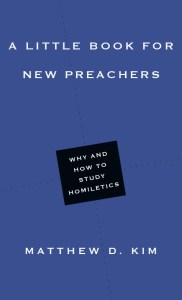
Book Review: Matthew D. Kim, A Little Book for New Preachers

Kim, Matthew D. A Little Book for New Preachers: Why and How to Study Homiletics. Downers Grove, Ill.: IVP Academic, 2020. 127 pp. Pb. $12.00   Link to IVP Academic  

This new addition to IVP Academic’s Little Book series focuses on preaching and teaching God’s word. Kim previous contributed Preaching with Cultural Intelligence: Understanding the People Who Hear Our Sermons (Baker, 2017) and is co-author of the forthcoming Finding Our Voice: A Vision for Asian North American Preaching (Lexham, 2020).

Little Book For New PreachersIn the introduction to the book Kim observes that he never felt he was a preacher. In seminary, he dreamed of living life in an ivory tower, as any good New Testament Skyler does. God challenged him during his seminary years to take preaching as “a glorious calling,” in the words of D. Martin Lloyd-Jones. For Kim, “Preaching is a privilege. God uses us week after week in the moment of preaching to make disciples who look more like a Jesus Christ…” (121).

Kim breaks the topic into three major sections. First, Why Study Preaching? In this section Kim deals with preaching as a “forgotten discipline.” In fact, preaching has a negative connotation in today’s evangelical church. Most churches are far more interested in developing worship experiences or other programs than the old-fashioned sermon. Many have observed the length of the sermon has been reduced radically in church is over the last 20 years. In fact, I would say most churches see the sermon as the “price you have to pay” to have a musical worship experience. As a result, preaching has become a brief devotional integrated into an entertaining worship hour.  For many pastors, preparing for a sermon is a burden. In order to preach a good sermon, a great deal of effort needs to be made and some pastors do not see this use of time as valuable in the overall busyness of ministry.

Second, Kim outlines the characteristics of faithful preaching. He begins with the discussion of faithful interpretation, with some suggestions on selecting passages topical versus expositional sermons and “twelve interpretive processes” which are necessary for developing a sermon. Based on Kim’s earlier work, includes a section on developing a “cultural exegesis.” The reason this is necessary is that there are wide cultural and generational gaps in most churches. Socio-economic and educational levels in most urban churches are diverse, making it difficult for a preacher to create relevant sermons. Kim quotes Keith Willhite, “listeners determine whether the sermon is relevant” (80). The preacher must take the time to address their congregation and determine what cultures will require immediate cultural exegesis. Essentially, he is calling for a faithful application of the scripture in the context of the culture in which the sermon is delivered.

Third, he develops the characteristics of faithful preachers. In his section on application, Kim encourages preachers to apply the text they are preaching first to themselves. In this section on the character of a faithful preacher, he discusses the warmth and directness necessary for preaching well. He recommends humility, realizing that the preacher is not a Superman, they must be themselves and they must like themselves. In addition, he warns against developing a “cult of personality.”  The final chapter of the book is perhaps the most important. Here he calls on preachers to pray for the Holy Spirit to lead their preparation and their presentation. It is quite likely that most preachers will pray for the spirit to guide them while they are presenting their sermons, but more rarely does the preacher daily pray for the Holy Spirit to lead their preparation time. I will encourage congregations to pray for their pastors in their preparation of sermons. If Scripture is challenging the pastor spiritually, then the pastor will preach the Scripture with much more power on Sunday morning.

Although this book is not a textbook on homiletics, it includes some basics for putting a sermon together. He also has included sufficient bibliography two point interested readers to popular manuals and textbooks for preaching in the twenty-first century.

A Little Book for New Preachers is an inexpensive book and would make an excellent gift to a student who is working hard on a ministry degree, whether in a Christian undergraduate program, seminary or at Ph.D level. Like other books in the series, the text is peppered with quotations from famous preachers and older preachers will find encouragement in this book.

NB: Thanks to IVP Academic for kindly providing me with a review copy of this book. This did not influence my thoughts regarding the work.