Paul Lawrence, The IVP Atlas of Bible History (Second Edition)

Lawrence, Paul. The IVP Atlas of Bible History. Second Edition. Downers Grove, Ill.: InterVarsity Press, 2024. 187 pages, HB; $56.99.  Link to IVP Academic

The first edition of The IVP Atlas of Bible History (IVP, 2006) was one of the books I reviewed on Reading Acts. In 2010 (nearly 15 years ago!) I did a series of posts on Bible Atlas and included The IVP Atlas of Bible History because I had used it as a textbook for both my Old and New Testament survey classes. I carried it with me to Israel as a resource for leading student tours in 2007 and 2009. This is the Bible Atlas I usually recommend to laypeople who want basic maps and background material as they read the Bible.

IVP Atlas of Bible History

Like the Oxford Bible Atlas, the IVP Atlas of Bible History is both a collection of maps and an overview of biblical culture and history. In addition to sections on the major sections of the Bible, the editors include articles on Geography of Canaan (for example, Climate of Canaan, Agriculture of Canaan), archaeology (for example, Archaeology of the Patriarchs, Evidence of the Conquest of Canaan), culture (for example, Writing, Archives and Libraries in the Ancient World, Travel in the Roman World), or historical background essays (for example, Language of the Bible, essays on Assyria, Babylon, Greece, Rome).

The atlas uses “paired pages” linking a map or chart with text describing the content. The oversized format (11.9×9.2 inches) allows for larger maps and a variety of other content. Numerous photographs illustrate the content, and sidebars focus on a more specialized subtopic. The inside margin of the paired pages has a small box that collects all the scripture references for the pages.

I opened both books on my desk and compared every page to compare the two editions. There are no major changes. There are no new topics or essays, and as far as I can tell, the text of the essays is identical between the editions (perhaps there is a typo or two corrected, but nothing substantial). The changes are entirely cosmetic. First, the second edition uses a sans serif font (Ariel style) rather than the serif (Times Roman style) font in the first edition. This makes the text easier to read, especially for those people struggling with dyslexia. Many style guides now recommend a sans serif font for accessibility. Second, colors used for the textboxes are softened. Most boxes no longer have borders, increasing readability. Third, some maps lost the relief style representing mountains (for example, the Persian Empire, p. 113, or Greece, p. 119). Other maps have a softer relief style. This makes for a more readable map, and honestly the “relief” was not particularly accurate. Fourth, I noticed one or two updated photographs. These might simply be lightened with a photo editor, but the image of Thutmose III (p. 49) is from a different angle.

Since this is a Second Edition, I expected some things to be updated. For example, there are no new photographs from the City of David excavations or the Ophel to illustrate First Temple Jerusalem.  The photograph of the Holy Sepulcher is now outdated, since the Cenacle has been refurbished. The published version has the wooden supports for the crumbling walls. Since the first edition, the Caiaphas Ossuary was discovered and would make an excellent addition to the atlas (replacing the James Ossuary, p. 149). Finally, since 2006, there has been much archeology and restoration at Laodicea. Up-to-date photographs of that location would enhance the section on the Seven Churches of Revelation.

Conclusion: Paul Lawrence passed away in February 2025, and Alan Millard passed in 2024. Heinrich von Siebenthal and John H. Walton are consulting editors for both editions. Siebenthal is known for his work on Greek grammars and linguistics, and John Walton published many books on Old Testament themes over the last 15 years. It does not appear any additional editing, consulting, or otherwise was done in the second edition.

If you own the first edition of The IVP Atlas of Bible History, you do not need to buy the second edition. There is no real “upgrade.” However, the new edition is a good investment if you want a solid Bible Atlas with an overview of biblical history and culture. I stand by what I wrote 15 years ago, The IVP Atlas of Bible History is an excellent resource for pastors and laymen, although the scholar might find the content inadequate for their needs.

NB: This atlas is published internationally as The Lion Atlas of Bible History, Second Edition (Lion, 2024). This version is available for Logos Bible Software. I appreciate IVP Academic’s generous offer of a review copy of this book, but this did not influence my thoughts about the work.



Book Review: Paul H. Wright, Understanding the Ecology of the Bible

Wright, Paul H. Understanding the Ecology of the Bible: An Introductory Atlas. Jerusalem: Carta Jerusalem, 2018. 48 pp.; Pb; $18.00. Link

Paul Wright is the President of Jerusalem University College (the Institute of Holy Land Studies). He has contributed to several other “introductory” Carta atlases including Understanding Biblical Archaeology and Understanding the New Testament, and Understanding Great People of the Bible.

This atlas has a narrow focus, the ecology of the Bible. As Wright suggests, a study of the ecology of the Bible is important because flora and fauna are the natural context of the Bible (7). The daily life of ancient Israel was embedded in an ecosystem, and many of these natural elements form metaphorical language of the Bible.

For each of the six chapters of the book, Wright cites a theme verse. This does not always make the topic of the chapter clear. In “In His Hand is the Life of Every Living Thing” (Job 12:10), Wright introduces the book by arguing for the importance of the land, plants and animals of the Bible in order to better understand the Bible. The second chapter, “How is the Land? Is it Fat or Lean?” (Numbers 13:20), briefly describes the land as “flowing with milk and honey.” As Wright observes, modern visitors to Israel are often surprised by the cry climate of the land. The third chapter deals with geology and climate (“A Land of Hills and Valleys That Drinks Water from the Rain of Heaven,” Deuteronomy 11:11). This is the most map-rich chapter in the atlas, with specialized maps charting the geology, soil types, and precipitation in both Israel and the Middle East. The chapter also includes brief descriptions of the various ecosystems present in the land, illustrated with photographs and at least one verse per section.

In the fourth chapter Wright describes plant life in Israel (“From the Cedar that is in Lebanon Even to the Hyssop that Grows on the Wall,” 1 Kings 4:33). These are illustrated with photographs of modern plants, but Wright shows these plants are known from archaeological evidence. He has examples of ostraca mentioning wine, barley grain, etc. as well as a few illustrations drawn from ancient papyri describing the agriculture of ancient Israel. Since this book is intended as an introduction, Wright’s list of plants and animals is far from comprehensive.

Chapter five, “For He Loved the Soil” (2 Chronicles 26:10), deals with agriculture in ancient Israel, but also examines the damage to the environment in modern times. He relates this damage to the abuse of the poor in the prophets.  The biblical authors, Wright says, recognized the benefits of both the shepherd and village farmer, and eventually urban centers (40), but always speaks in favor of humane treatment of animals and wise use of the land. The reason is the land and all the animals belong to the Lord (Psalm 50:10-11). This is far from a chapter on responsible Christian environmentalism, but Wright offers some pointers in that direction. In the final paragraph of the book, he bemoans the lack of emphasis on environmentalism among biblically oriented Christians (47).

The final chapter demonstrates Israel’s conception of time was tied to the land (“A Land for Which the LORD Your God Cares,” Deuteronomy 11:12). Beginning with one of the earliest extant Hebrew texts, the Gezer Calendar, Wright how the years, days and weeks are integral to Israel’s relationship with their environment. The final page of the chapter traces the importance of Eden in the Old Testament and serves as a conclusion to the book.

The book is richly illustrated with full color photographs illustrating geographical features, plants and animals. Since Wright is credited with most of the photographs, these are not the same images used in other publications. However, for an atlas, there are not very many maps, only fourteen in all.

One minor criticism of the book is a misleading title. Although the book claims to be an ecology of the Bible, it is really an ecology of ancient Israel. Certainly olive oil and pomegranates are the same in the New Testament, but there is little here specifically on the New Testament. Much of the plot of the New Testament in the book of Acts takes place in Asia Minor, which goes beyond the scope of this book.

Conclusion. Like the other volumes in this Introductory Atlas series, the book is 9 x 12 inches and only forty eight pages. This makes for an inexpensive book, although it is not a durable handbook one might toss in their backpack on a trip to Israel. This is not a Carta Field Guide (on Masada, En-Gedi, and Qumran). Nevertheless, Wright has contributed a good introduction to the physical environment in which the Bible takes place.


NB: Thanks to Hendrickson and Carta Jerusalem for kindly providing me with a review copy of this book. This did not influence my thoughts regarding the work.

Top iPad Apps for Bible Study (Part Two): Bible Atlases

Bible Atlas for the iPad

I reviewed several new Bible Atlases last summer (see my conclusions here).  Several of these are available for Kindle (Holman, Oxford), but the IVP and ESV Bible Atlases are not.  Books in the Kindle format read like any other Kindle book.  On the iPad you can zoom in on maps and pictures, but the resolution is not particularly high.  I purchased the Oxford Bible Atlas (fourth edition) for Kindle and was very disappointed. The maps are not really readable, and it is useless to zoom in.  Even if I simply fill the screen with the map it is too pixelated to be of use.  In fact, I am a disappointed with all the Bible Atlases on the iPad.  There is no single app which satisfies my need for quality maps on the iPad.  here is what I am looking for:

  • High Resolution Maps. I want to be able to zoom in close and not have a pixelated mess.
  • Detailed Information, clickable links.  I want to link to a dictionary style entry which gives me a brief overview of the history and geography of the location with the possibility of linking to a serious encyclopedia entry.
  • Current Information.  I do not really want a link to an old Bible Dictionary, I want the latest scholarship on the location.
  • Zoom on Rotation. Many maps are better viewed in landscape rather than portrait orientation.  It should not be difficult for an app to sense rotation and fill the screen.

There is really no iPad Bible Atlas App which comes close to this, here are a few comments on the “best” Atlases for the iPad.

Logos Bible Software.  (Free, App Store).  The free Logos App does not come with any Bible Atlas, but I own the Holman Bible Atlas ($29.95, but included in several of the Logos collections).  There are remarkably few Bible Atlases in the Logos collection, which I find surprising.  The The Holman Atlas has a nice collection of sidebars and charts along with 132 maps and a nicely written history of the Bible. The maps in the Holman Bible Atlas are reasonably clear, but I cannot zoom in to see the details on the map.  There is text on the map giving details for locations which is unreadable on the iPad.  This is a problem with the Logos App not the Atlas itself.   The Logos Deluxe Map Set edited by Thaine Norris ($29.95, included in all Logos collections) are not particularly useful in the iPad either since they cannot zoom nor do the expand when the iPad is rotated.

Carta Compact Atlas HD ($4.99, App Store) and Biblical Jerusalem – A Carta Atlas ($7.99, App Store).  These apps are essentially collections  of scans from Carta Atlases.  This is not bad, but there is not a lot of detail beyond the maps.  The Compact Bible Atlas has no search capability, and the maps are more or less the type you find in a good Study Bible.   Biblical Jerusalem is a bit better with respect to maps, but the app itself is little more than an index to the maps.

Big Bible Maps (Version 1.8, $2.99, App Store).  BibleStudyPro has a host of iPad apps, including several map collections.  For the most part, everything on this site is public domain, which limits the usefulness of the apps.  This is especially true for maps, since a free Atlas from 1850 is not particularly useful. BibleStudyPro apps are inexpensive, all are priced at $2.99.  A few Android versions of their apps have appeared, I expect all to be ported eventually.  The best of the apps from BibleStudyPro is Big Bible Maps.  The app tags satellite maps from Google Earth with biblical places.  Since the images are from Google, you can zoom in extremely close for amazing detail.  The obvious problem is that Google Maps are modern maps!  Once on the map, you must touch a pushpin to identify the location. The location flag will appear, and if there is an arrow you can open a description of the location.  The text is drawn from the original International Standard Bible Encyclopedia, although this is not identified in the software as far as I could see.

The opening screen offers three options.  First, locations are arranged by chapter and book.  If I select Joshua 4, I am taken to a Google Earth map with push-pins at locations for that chapter (Jericho, Gilgal, the Jordan River, and oddly enough, Israel).  I could not find all the locations in a book, a chapter must always be specified.  Only chapters with locations appear on the menu, so Matt 6 does not appear, but Matt 4 does.  Second, you can select locations from a list (Jerusalem and Jericho appear at the top, otherwise it is alphabetical). Third, you can search by typing the name of the location.

This app is mystery to me since Google Earth is already a free app and the ISBE is freely available on Google books.  What is more, Google Earth links locations to Wikipedia and Flickr, providing (in some cases) better information than ISBE.  There is some value to having this information in a single place, so this app may satisfy a need.

The bottom line is that a good Bible Atlas has yet to arrive for the iPad.

New Testament Atlases

Bill Heroman kindly included a link to the recent atlas reviews in his June Semi-Carnival.  In my review conclusion, I complained (gently) that the New Testament gets the short end of things in these atlases, with the Pauline sites dismissed in a few pages.  Bill pointed me to the Barrington Atlas of the Greek and Roman World, edited by Richard J. A. Talbert.  This is obviously an excellent resource for maps of interest to students of the book of Acts and the classical world in general.  I did not include it for several reasons, but primarily because the four review atlases were recent releases (three from 2010) and these four are most likely to used by pastors and laymen.  At $248 ($375 with CD-ROM), the Barrington is a serious tool to be found in serious libraries.  This points out the problem for a New Testament atlas: how would it differ from a classical world atlas?  Presumably an emphasis on Palestine and Jerusalem, but for Acts the major cities are well documented by standard historical atlases.  I have owned the microscopic Atlas of Ancient and Classical Geography (originally printed in 1907) for years but still find some of these maps to be useful.

I also appreciate Bill’s comment that this recent spate of Bible Atlases blur the line between an atlas and a Bible dictionary, or at the very least a Bible Handbook.  Usually this falls into the category of a “Historical Atlas” which covers the history of the Old Testament and intertestamental period sequentially.  I suspect this is to make the book a better choice for a Bible Survey course, which increases sales.

One or two items came to mind as I thought about New Testament geographies. Since I am unlikely to  find a purely NT atlas, books like these will have to fill this gap.

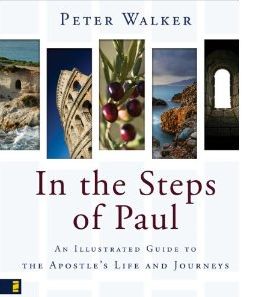
I have used Peter Walker’s In the Steps of Paul: An Illustrated Guide to the Apostle’s Life and Journeys (Grand Rapids: Zondervan, 2008, 213 pages, $19.99) for an undergrad Acts class.  This book is a follow-up to his 1997 In the Steps of Jesus: An Illustrated Guide to the Places of the Holy Land and attempts to deal with locations outside Palestine and Jerusalem since they were covered in the first volume.  These two books are richly illustrated with maps from Total Media Services and photography provided from the author, Todd Bolen, and a number of stock services.  In the Steps of Paul focuses a chapter on the major cities visited by Paul in the order of their appearance in the book of Acts.  Walker provides a sketch of the history of the city usually accompanied by a time-line and city map.  It is helpful that his time-lines extend to the modern period and include the excavations of ancient cities.  The bulk of the chapter is a sketch of Paul’s interaction with the particular city, using both Acts and the epistles.  The chapters conclude with a section on the “city today.”  This is a very handy guide of what to see if you visit the cities of Paul, including both earlier Roman and later Christian points of interest. Walker’s In the Steps of Paul in a good guide to the text of Acts and the general history of the cities Paul visited.  It is neither an atlas nor a guidebook, although it has elements of both. Still, these two volumes are both refreshing to read and can be used by both pastors and laymen to orient their thinking geographically when reading Acts.

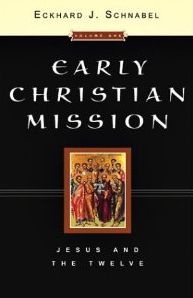
On the other end of the spectrum is the massive two-volume work by Ekhard Schnabel, Early Christian Mission (Downer’s Grove: Inter-Varsity Press, 2004, 1928 pages, 2 Volumes, $90.00).  While this is not an atlas, I have made a great deal of use of the second volume which covers Paul and the Early Church. For each of the sites mentioned in Acts, Schnabel provides a historical sketch worthy of any dictionary or encyclopedia.  These brief sections are fully conversant with the literature of classical historical scholarship, but they are intended to support his running commentary on the book of Acts.  This volume includes 39 maps and charts illustrating the text.  Some of these are the “usual suspects” (Palestine, the Roman World), but others are unique.  For example, to illustrate how the ancient world understood itself, Schnabel includes the world map of Eratosthenes as well as a world map according to Jubilees. Basic city maps of many of the major cities Paul visited are also included (Antioch, Caesarea, Damascus, etc.)  These are far from the quality one would expect in an atlas.  The map of Rome is so small it is nearly useless.  But as illustrations of the excellent text they serve well.

This massive work is neither a biblical commentary nor a Bible Dictionary, although it combines elements of commentary and dictionary to describe the world the Gospels and Acts.  In my view, it is indispensable for the study of Acts. It is no atlas, but the information is in the book to be discovered.

Bible Atlas Review: Conclusion

Over the last two weeks I have posted reviews of four major Bible Atlases released in the last few months.  All four of the atlases reviewed are excellent and each would be an important addition to any library.  Each has strengths and weaknesses, but each is worth owning and using in personal Bible study.

Best Maps: ESV Bible Atlas.  The maps in this volume are detailed and clear, and the Regional Maps section goes well beyond the other volumes reviewed. The maps are detailed and complete, including Italy, Macedonia and Achia, Western and Southern Anatolia, Mesopotamia, Palestine, Sinai and Egypt.  These maps span two large pages and are printed to the interior edge of the page so nothing is missing.

Best Photography: Zondervan Atlas of the Bible. I think I was drawn to the photography in this Atlas because more than once I saw a picture which I took on one of my trips to Israel.  The atlas treats us to some unusual angles of traditional sites as well as photos one does not often see in an atlas.  I found myself browsing through this Atlas for the pictures more than the others.

Best Illustrations: ESV Bible Atlas. The drawings of the city of Jerusalem and the Temple in various periods provide a concrete view of scholarly speculation.  The IVP Atlas has excellent illustrations as well, but the ESV illustrations are more rich in details.

Best Articles: ESV Bible Atlas and The New Moody Atlas of the Bible. Both of these volumes are worth considering for a college level Old Testament survey course.  The Zondervan Atlas is nearly as good, but the depth of the ESV and Moody atlases is hard to beat.  I might give the edge to the Moody Atlas since it includes a great deal of documentation and footnotes.

Best Layman Atlas: The IVP Atlas. The maps are clear and the art well-presented.  The articles are brief and contained to a pair of pages.  I can imagine someone using this Atlas while reading through Joshua or Judges and tracking events on the maps.  The IVP Atlas is not “dumbed-down” by any means, but will likely be a favorite for the casual reader.

Best Scholarly Atlas: ESV Bible Atlas. While the New Moody Atlas is close, there is simply more details provided in the ESV Atlas.

What is missing from these Atlases?  As I said a few times in the reviews, I like to compare the map of David’s to Solomon’s Jerusalem, to Nehemiah’s Jerusalem, and then to the New Testament period.   This is harder to do with these maps on separate pages.  I would have liked two facing pages with all four periods on it.  What ever happened to the plastic overlays that used to appear in Atlases and encyclopedias? I suppose they have been dropped to keep price down, but they could be useful for demonstrating the growth of the city of Jerusalem.

Another general problem with Bible Atlases is that they seem to be limited in the New Testament period.  A few pages for the world of Jesus and then a few more for the Pauline mission.  I know that the “biblical world” tends to refer to the Canaan, but there is far more that could be done on the Roman world in which Paul ministered.  Some of this is in Ephesus, Corinth and Rome could be given more details and maps.  All the atlases include a section on the seven churches of Revelation, but these  cities were already a part of the Pauline mission.  Dismissing the geography and history of Asia Minor in two or three pages covering the seven cities seems to me too limited.  I would like to see an atlas that was focuses solely on the New Testament geographically and historically.

These four volumes are all excellent contributions to the study of the geography of the Bible. I think that the ESV Bible Atlas and the New Moody Bible Atlas would make excellent textbooks for an Old Testament survey course, although all four would serve well.